Prologue
What follows is a true thing, for the most part. The bones of it are a matter of record: a battle on a Somerset moor in the summer of 1685, a church full of prisoners, a judge at Wells, and a ship called the Constant Richard that carried a man named Edward Chedsey to Jamaica. The flesh on those bones, the words the brothers spoke and the things they felt, no record holds. Those I have imagined, as faithfully as I could, for two real men who lived and were not written down. It was a story passed along the years, from mouth to mouth, until it reached me. This is my turn to tell it.
There is a flat country in the west of England where the land lies lower than the sea, and only the patience of men keeps it from drowning. They cut ditches through it, straight as a sermon, and call them rhines. They lay planks across the ditches and call them plungeons. On the small rises of dry ground they built their villages, and gave them names that end in the old word for island, because in winter that is what they were. Islands in a brown and reedy sea.
On one of those islands stood a village called Chedzoy, and from that village, long ago, a family had taken its name and carried it away. By 1685 they lived some miles to the south, on another of those islands, in the parish of Stoke St Gregory; but they were the Chedzoys still, named for a place most of them had never lived. In that year two brothers of that family walked off their island and went to war against the king. Only one of them came back to the world, and he came back changed, and far away, and never to Somerset again.
This is how it was remembered. This is how it has been carried. Begin where they began, in the spring, with the water still and the work unending, before the news came up the road and made the whole of England small.
The Island in the Moor
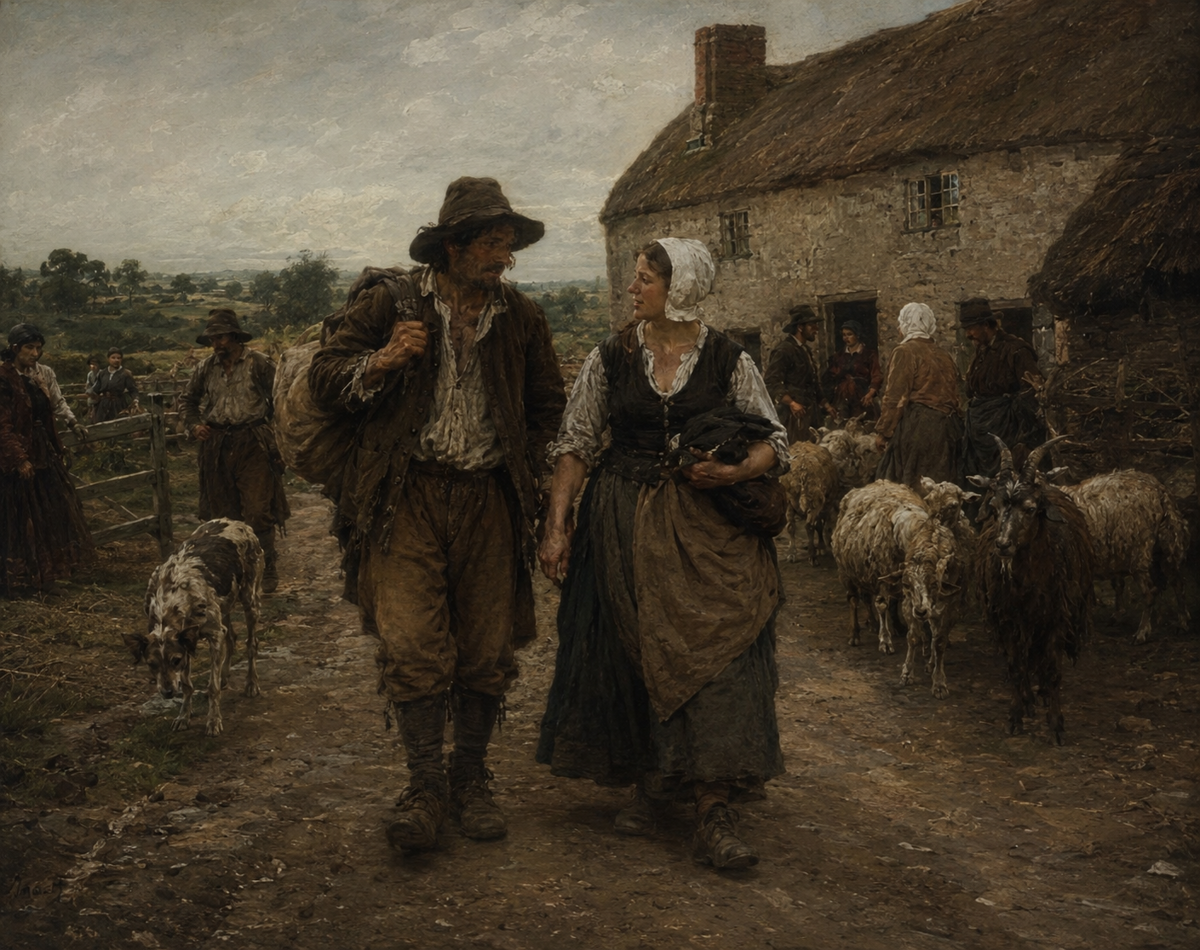
A village on its island in the Somerset Levels, of the kind the brothers knew at Stoke St Gregory. Illustration generated for this story.
Edward Chedzoy could read the weather in the rhines before he could read it in the sky. The water in the ditches lay still and brown and told him things. When it darkened and the surface went tight as a drum, rain was coming off the Quantocks within the day. When the midges hung over it in a low cloud, the heat would hold. He had learned this without ever being taught it, the way a man learns the face of his own mother.
He was bent to the withy beds on a morning in the April of that year, cutting the willow low and clean and laying the rods in bundles. It was good work, quiet work, the kind he liked. Behind him the village ran along its low ridge of firm ground, a tongue of higher land thrust out into the wet, with Curry Moor and the River Tone on the one hand and West Sedgemoor on the other, and the old island of Athelney off to the west where King Alfred was said to have hidden among the reeds. This was Stoke St Gregory, withy country, where the willow grew straighter and thicker than anywhere on the Levels and half the parish lived by the cutting and the weaving of it. St Gregory's church stood on the ridge, square and grey, and the dean and chapter of distant Wells held the manor and took their dues. Cattle stood to their hocks in the summer pasture out on the moor. Eels moved in the rhines. Smoke from the peat fires lay flat over the thatch. It was the only world Edward had ever wanted, and he had been quietly saving toward a larger piece of it: a holding of his own, and a girl named Joan Hurd who lived past the church and who had not yet said no to him.
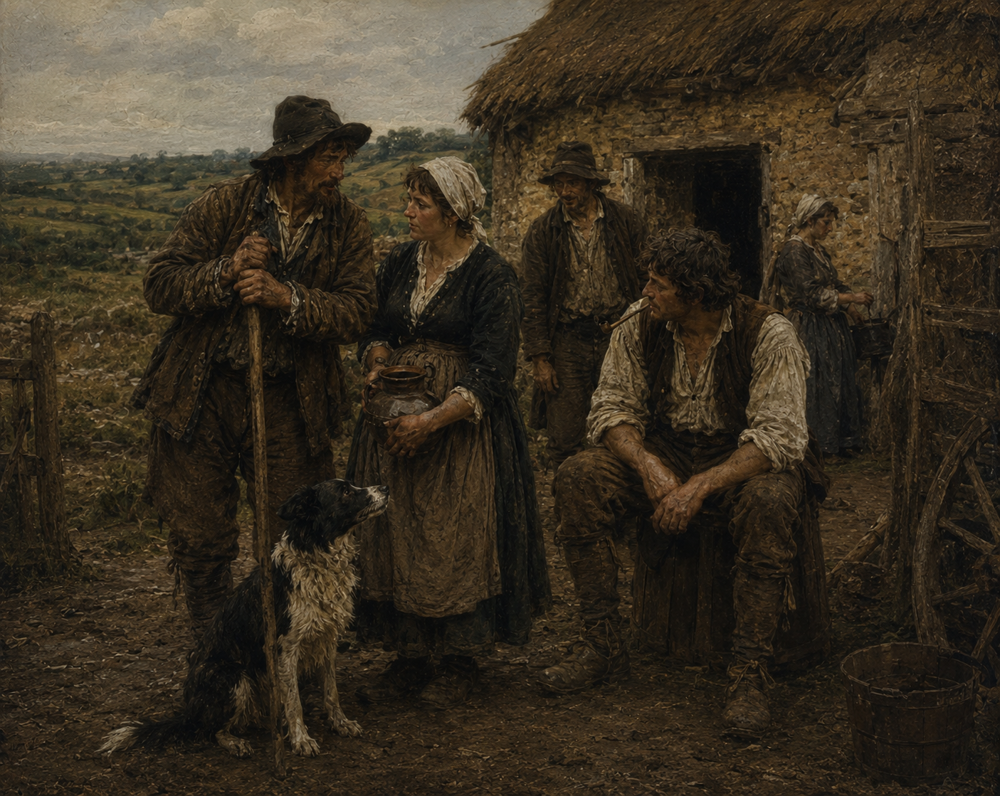
Edward, the cautious younger brother. Illustration generated for this story.
His brother Robert came across the moor with the morning still on the grass, and Edward knew from the set of his shoulders that there had been words again at the alehouse.
Robert was the elder, named for their father as the eldest son so often was, and he carried it like a commission. Where Edward was made of patience, Robert was made of heat. He was a big man, quick to laugh and quicker to anger, and when he spoke in the alehouse other men set down their pots to listen. He was a Dissenter to the marrow, the kind of Protestant who would not bow his head in the parish church if he could help it, and who felt the weight of the tithe and the bite of the failing cloth trade as a personal insult laid upon him by powers in London he had never seen.
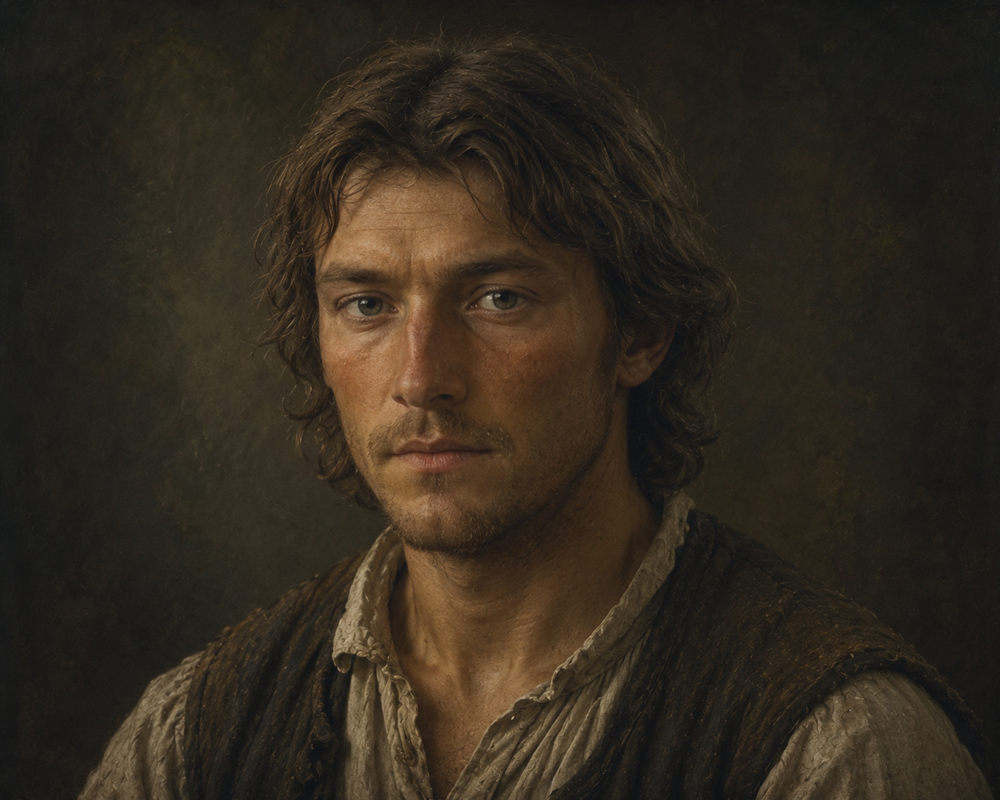
Robert, the bold elder brother. Illustration generated for this story.
"They've a new collector coming for the tithe," Robert said, dropping down onto the bank. "And the weavers at Bridgwater are half of them idle. There's no wool money moving. And we've a papist on the throne who'd have us all hearing the Mass within five years, mark me."
"We've a king," said Edward, reaching for another rod. "Same as we had a king last year and the year before. Kings come and go and the willow still wants cutting."
"You'd say that with the house afire."
"I'd say it with the house afire because the saying of it never yet put a fire out." Edward straightened and looked at his brother, and his voice gentled, because he loved him. "Rob. You'll talk yourself into a corner one of these days, and there'll be no quiet road out of it."
Robert grinned at that, the old grin, the one that had got them both into trouble since they were boys taking eels they had no right to. "There's worse things than a corner," he said. "There's a whole life spent never standing in one."
The Alehouse
There was an alehouse on the Stoke road where the men of the parish gathered of an evening, and it was there, more than at any pulpit, that the talk of the times caught fire. Edward went because his brother went, and his brother went because their father went, and the old man went oftener than was good for him or for the few coins the house could spare.
Robert the elder was loud in his cups, and he was in them most nights now. The drink loosened the tongue the day's work had kept, and out it would come: the papist on the throne, the bishops, the tithe that took the bread from an honest man's mouth, the same grievances worn smooth as river stones from the handling. Men listened, for there is a kind of certainty that drink lends a man that sober reason cannot, and the old man had it by the jugful.
Young Robert sat apart, a knot of the parish's daughters and idle lads gathered about him, for he had the gift his father had spent: he could hold a room without raising his voice, and the maids liked the look of him, and he knew it. When the talk turned to the Duke, and whether the West would rise, it was the son the young men leaned toward, and the father saw it, and did not like it.
"There's a wind getting up in the West," Robert said, "and I mean to be standing in it when it comes."
"You?" His father's voice came thick across the room. "You're a boy with a loud mouth and a row of maids giggling at it. When I was your age I'd have..." and what he would have done was lost, for the drink had taken the end of the sentence.
"When you were my age, Father, you talked," said Robert, and there was no cruelty in it, only the plain hard truth a son saves up for years. "I'll do more than talk."
Edward put a hand on his brother's arm. "Rob. Leave it. He's had a skinful. Let's get him home before he says it to the wrong pair of ears." But no one was listening to Edward. No one ever quite was, and he had long since made his peace with it, or thought he had.
The Hearth
In the house on the ridge the evenings had their own order. Elizabeth sat at her wheel by the fire, the wool turning to thread under her hands the way it had for thirty years, though the cloth trade was failing all about them now and the thread fetched less with every season. She spun, and she listened, and she said little.
Their mother Elizabeth fed them that evening at the long board, moving between the hearth and the table without a word wasted, the way she did everything. She was a small, still woman who had buried two children between Robert and Edward, and had learned somewhere in that to spend her feeling carefully and to keep the most of it shut away where it could not be reached. She set down the bread and the pottage and the small beer, and she watched her sons over it with a quiet that strangers took for meekness and that Edward knew to be something else, watchful and deep, like the moor water she had taught him without teaching to read.
Their father said the grace, and it was their father who turned the talk, as he turned all talk in that house, to the one subject that ever truly held him. Robert the elder was a hard, upright man with a voice made for the open air and a certainty in him like a roof-beam, and he had raised his sons on the Book and on his grievances in roughly equal measure. He could not let a meal go by without coming round to the papist in London, to the bishops, to the tithe that took the bread out of an honest man's mouth and put it in the mouth of a clergy that prayed in the wrong direction. He laid these things on the boys the way he laid the law down on his fields, as matters not open to dispute, and he had been laying them there since the two of them were small enough to sit under the board rather than at it.
Robert had drunk it in like a calf at the pail. Every word of the old man was in him now, grown hotter in the growing, and when his father spoke of standing up like men the son's jaw would set and his eyes would go to some middle distance where, Edward suspected, he was already standing. Edward had taken the same words and done the other thing with them. He had learned, young, to keep his head down over his plate and his counsel behind his teeth, and to let the weather of his father's talk blow over him and pass. It was not that he thought the old man wrong. It was that he had seen, even as a boy, where such certainty ran to in the end, and he had never had the stomach for the running.
Elizabeth said nothing through any of it. She filled the bowls and she gathered them, and only once, when her husband's voice rose and Robert's rose to meet it and the word rising came into the room for the first time that spring, did she look up sharp from the hearth, a quick hard look that went straight to her elder son and held him a moment. Then she lowered her eyes and banked the fire, and the moment passed, and none of the men remarked it. Edward remarked it. He had spent his whole life reading the things that did not announce themselves.
The parson had preached obedience again on the Sunday past, up at St Gregory's; and over at Chedzoy, the very village the family's name had come from, the rector Andrew Paschall was preaching the same. Paschall was the king's man through and through, a careful, clever clergyman who kept records and watched the sky for portents, and whose account of all that was coming would one day be the official one. Robert had sat through their own parson's sermon with his jaw working and his father beside him doing the same. Edward had watched the two of them, the old man and the young, the same fire banked in the one and blazing in the other, and felt the old fear move in him, small and cold, like a fish turning over in the deep water of a rhine. He could not have said, then, what he was afraid of. He only knew his brother was a lit thing, and the man who had lit him sat at the head of the board, and the country round about was very dry.
There were nights the drink brought home more than her husband's temper. On those nights a thing was expected of her that the years had long since emptied of any tenderness, and she had no word for it, and no one to tell, and so she did what wives did, and was somewhere far off inside herself while it lasted, and never spoke of it. She had buried two children in that churchyard already and wanted no more; she was not asked. It was the lot of women as she had been given to understand it, and she bore it as she bore the rest, in silence, by the fire.
Joan
There was one place in the world where Edward's tongue came loose. Past the church, where Joan Hurd lived, the stammer that took him in front of his father and his brother fell clean away, and he could say what he meant.
"I cut the long bed today," he told her, in the last of an evening's light. "Cleanest rods I ever laid. And I got to thinking. If I can take the Lower Withers off the dean's man come Lady Day, and if you'd have me, a man could make a start on something. A holding. A life of our own."
She was plain enough to the eye, Joan Hurd, but there was a quiet in her that grew on a man, and she was the best listener Edward had ever known. "You'd make a fine go of it, Ned," she said. "I never met a body works as steady as you." And she meant it. She hung on his every word as though it were Gospel, and in her eyes he was not the overlooked younger son but a man worth the hearing.
"You're the only soul I can say it to," he said. "Up home it's all Father and Rob and the king and the Duke, and I can't get a word in edgeways. But here I can think straight." Then the lightness went out of him. "Rob's got the rebellion in him, Joan. Bad. And Father eggs him on every night of the week. I'm afeared of where it ends. I'm afeared he'll go."
"Then you'll keep him sensible," she said. "You always do." She believed he could. She believed near everything he said. It was, he thought, walking home in the dark, the best hour of his week. He did not know how few of them were left.
News from the Sea
The news came up from the coast on the eleventh of June, and it came the way such things always come, in pieces, ahead of the truth. A rider through Bridgwater. A pedlar with a tale. A Dissenting preacher who had it from a man who had it from Lyme itself. By the time it reached Stoke St Gregory it had the shape of scripture: James Scott, Duke of Monmouth, the dead king's own son, the Protestant Duke, had landed at Lyme Regis from Holland with a small company of men and a great banner, and the banner read Fear Nothing but God. He had come to take the throne from his Catholic uncle. He had come, the preachers said, like a deliverer.
Robert heard it at the alehouse and came home with the news in his face, and Edward, cutting peat out on the moor, saw him coming and felt the quiet life he had been saving toward grow suddenly a great deal smaller.
"He's landed," Robert said. "At Lyme. The Duke."
"Then God help the fools who follow him," said Edward, and bent again to the turf.
But Robert did not laugh, and that was the first time Edward was truly afraid.
Through the week the word grew firmer and worse. Monmouth had come ashore with no more than fourscore men, but the West was rising to him. He had gone inland through Axminster, where there had been a sharp clash with the militia in the middle of the month and the militia had melted away rather than fight their own. Through Chard. Through Ilminster. Men were leaving their looms and their fields and walking to him with whatever they could carry. The country was Protestant to its heart and poor in its belly, and here at last was a man saying out loud the things that had only ever been muttered.
"Eighty men," Edward said that night, low, so their mother would not hear. "Eighty men against the king's army. Trained soldiers, Rob, with horse and cannon, and us with billhooks."
"It was eighty at Lyme. It's hundreds now. It'll be thousands. The Lord doesn't count the way you count."
"The Lord didn't count at Lyme. Men did. And the king has more of them, and better."
They argued in whispers across the dark of the loft until their father's voice came up through the boards and bid them sleep. They lay quiet then, both awake, and Edward listened to his brother breathing too fast in the blackness and understood that the argument was already lost. Not the argument of words. He could win those. The other argument, the one underneath, the one that had been settled before either of them was born by the simple fact that Robert was the elder and the bolder and the one Edward had followed his whole life.
The Duke Made King
They walked to Taunton to see it, because Robert could not be kept from it and Edward could not let him go alone.
The town had gone mad with hope. The streets were strewn with flowers and green boughs, and women had hung sheets and ribbons from the windows, and the maids of the town had made the Duke a set of colours with their own hands. On the twentieth of June they proclaimed him king at the Market Cross, James the Second, the true and Protestant king, and the cheering went up off the rooftops like a flock of birds. Edward stood in the press of it with his brother's hand gripping his shoulder and felt the pull of the thing in his own chest, the great warm dangerous tide of it, men he did not know weeping and embracing him as if the kingdom of heaven had come down into Somerset.
And he saw the army, and the seeing of it cured him faster than any argument could.
They had made it into regiments and given them the names of colours, Red and Blue and Green and White and Yellow, and there was a troop of horse and a few small guns. But the men. The men were husbandmen and weavers and peat-cutters, his own kind, and they were armed with what the fields and forges of the West could give them. Scythe blades lashed to eight-foot poles. Pitchforks. Hatchets. Clubs. Here and there an old musket or a pike, and the horsemen, many of them, were up on plough-horses that had never heard a gun. Men were already calling it the Pitchfork Rebellion, and not always kindly.
"Look at them," Robert breathed, and his eyes were shining. "There's the West risen. There's free men."
"There's dead men, Rob," Edward said, very quietly, but the cheering took it and he was not sure his brother heard.
The Duke reached Bridgwater the next day to a welcome like a saint's. Edward and Robert watched the colours come in along the road, and Edward looked at the scythe blades catching the late sun, beautiful and terrible, and he thought of the willow standing uncut in the beds at home, and of Joan Hurd, and he said nothing at all.
The Persuasion
It was in the last days of June that the hope began to sour, and it was in the souring that Robert came for him in earnest.
The news that filtered back to the Levels was all of the wrong kind now. The Duke had marched north for Bristol and found the bridge broken at Keynsham and the great city shut and garrisoned against him. There had been a wet, ugly little fight at Keynsham on the twenty-fifth, the rain coming down in ropes. There had been a harder one at Norton St Philip on the twenty-seventh that the rebels had by some accounts won, but it had not felt like winning. The roads were mud to the axle. And then the worst of it: word came that the Earl of Argyll, who was to have raised Scotland for the cause, had been taken and put to death at the end of the month, and his rising had come to nothing. The Duke's men began to slip away in the nights, ones and twos, back to their farms, and who could blame them.
Robert came to him by the river in the dusk, and there were no flowers in his face now. There was something harder and more frightening, a man who had given his whole heart to a thing and could feel it failing and had decided to give the rest of himself rather than watch it fail without him.
"They're falling back on Bridgwater," he said. "The army. It's coming to a fight, and soon, and they need every man that can hold a blade." He stopped. "I'm going, Ned."
"It's lost, Rob." Edward heard his own voice shake. "You said yourself it'd be thousands and a deliverance. Look at it. Argyll's dead. Bristol's shut. Men are running home in the dark. It's lost, and you know it's lost, and you'd still go."
"Because it's lost." Robert's voice cracked on it. "Don't you see? It was easy to follow him when the bells were ringing. Any fool can follow when it's winning. It's now that it means something. It's now that a man finds out what he is." He took Edward by both arms. "I can't stay home now and live the rest of my life knowing other men went and I sat by the fire. I'd rather be dead. I would, Ned, I'd rather be dead in a ditch on that moor than be that man."
"And what am I to tell Mother?"
"Tell her her sons did right." Robert's eyes were wet. "Come with me. I can't ask it and I'm asking it. I can't do it without you. You've a steady head where I've none, you always had. You'll keep me alive out there. And I'll not have you safe at home hating yourself for the rest of your days, because I know you, and you would."
Edward stood in the wet grass with the river going by, and he thought of every quiet thing he wanted, the holding and the girl and the years of cutting willow, and he understood that none of it would taste of anything ever again if he let his brother walk out onto that moor alone and the moor kept him. It was not zeal that moved him. He had no zeal. It was the plain unbearable arithmetic of love, that there are some people you cannot let go into the dark by themselves, whatever it costs, because the cost of the other thing is higher.
"You're a fool," Edward said, and his voice broke, "and I'm a worse one." And that was his yes.
They went home in the dark and told them.
What the Mother Said
The father took it the way Edward had known he would, and dreaded he would. He stood up from his stool and was quiet a long moment, and then he put his hand on Robert's shoulder and then on Edward's, and his voice when it came was thick. "Then you'll go as my sons," he said, "and you'll do the thing I was too old and too late to do myself. There's no shame in this house tonight. There's only honour, and I'll not have it watered." His eyes were bright. He believed every word. He had believed it all their lives, and now the believing was walking out of his door in the shape of his two boys, and he could not see, or would not, that it had ever carried a weight of its own.
It was then that Elizabeth, who had not spoken, spoke.
She came up off the hearth and crossed the room, and the stillness that had wrapped her for thirty years tore straight down the middle. "No," she said, and then louder, "No," and she was between her sons and the door before any of them had seen her move. She rounded on her husband, and Edward had never in his life seen her lift her face to the old man like that, square and burning. "You'll send them, will you. With your fine words. You've had fine words since they could crawl, and now you'll spend them. You'll spend my boys on a duke that'll be a corpse or a king by harvest, and either way it'll not be your blood that pays for it. It'll be mine." Her voice cracked and did not stop. "I buried two of them in that churchyard. Two. And I held my tongue while you filled the two that lived with all of this, because a wife holds her tongue. I'll not hold it now. Robert. Edward. You will not go."
The room was silent. The father said her name, low, a warning and a plea together, and she did not so much as turn to it.
"Mother," Robert said gently, and there were tears standing in his eyes, "it is already done. We have given our word."
"Then unsay it. Words can be unsaid. I have watched men do nothing but say words in this house for thirty years, and there is no easier thing in the world than the taking of them back."
"Not this one," Robert said.
She looked at him a long moment, her firstborn, the one with all his father in him, and something went out of her face. Not the love. The hope. And Edward thought it was the worst thing he had ever watched happen to a living person. Then she turned to Edward, and her voice dropped, and it was for him alone. "You," she said. "You were always the one with sense. I am not asking you to keep him home. God Himself could not keep that one home. I am asking you to bring him back. And if you cannot bring him back, then you bring yourself. Do you hear me. One of you walks back through that door. Swear it to me. Swear it now."
"I swear it," Edward said. He did not believe it. He said it because it was the only thing in the world he had to give her, and she took it the way a body takes a thing it knows to be worth nothing and is yet all there is. She held his face a moment in her two rough hands, and then she stood aside from the door. She had spent it all, the whole hoard of thirty years, in five minutes, and there was nothing left in her to spend. She went back to the hearth and sat and looked into the fire and did not speak again while they gathered what they would carry.
Her husband stood in the middle of his own house with his certainty all around him in pieces, and could not meet the eye of either son. He had got what he had preached. Going out into the dark with his brother, Edward understood that there are men who never learn the price of a thing until it is carried out of their door, and that his father had learned it that night, and would have the rest of his life to study it.
Bridgwater, the Last Night
The Duke brought his army back into Bridgwater on the third of July, and the brothers came in among the stragglers and were swallowed by it.
Edward had thought, from outside, that an army was a fearsome and ordered thing. From inside it was mud and noise and prayer and waiting. The men slept in the streets and the Castle Field and the church. They were tired to the bone and many of them were sick, and the fervour of Taunton had worn down to something grimmer and in its way more moving, a stubbornness, a great weary determination to see the thing through. A grey-haired weaver shared his bread with them without being asked. A Bridgwater man with a carpenter's hands, who said his name was John Coad and that he had come up from the Ilminster country, showed Edward how to lash a scythe blade so it would not fly off at the first stroke, and talked low and steady of his wife and his trade, and Edward was glad of him in a way he could not have explained.
On the night of the fourth or the fifth a cattle-herder came in off the moor with news that changed everything. His name was Richard Godfrey, and he was a young man who knew the lanes and ditches of Sedgemoor the way Edward knew the rhines at home. The king's army, he said, lay camped out in the open by the village of Westonzoyland, not three miles off, behind a great wide ditch called the Bussex Rhine. They were at their ease. They thought no attack would come across that wet ground in the dark.
The Duke climbed the tower of St Mary's in Bridgwater and looked out across the flat moor with his spy-glass, and from the high cold stone he made his decision. They would not wait to be beaten in the daylight. They would go out across the moor in the black of the night, in silence, guided by Godfrey, over the plungeons that crossed the rhines, and they would fall on the king's men asleep.
"A night march," Edward said to his brother, when the word came down the ranks. "Across the moor. In the dark."
"God's own cover," said Robert. His fear had burned off entirely now. He was lit again, lit and calm, a man who has stopped arguing with his fate. "He's given us the dark to hide in. Don't you feel it, Ned? He's with us tonight."
Edward did not feel it. He felt the cold coming up out of the ground and the weight of the scythe pole in his hands, and he counted, the way he always counted, the ditches they would have to cross and the miles in the dark and the number of trained soldiers waiting behind that rhine. But he held his tongue, and he stayed close to his brother, and when they were given the order to make ready he tied Robert's blade as well as his own, twice over, so it would hold.
The Silent March
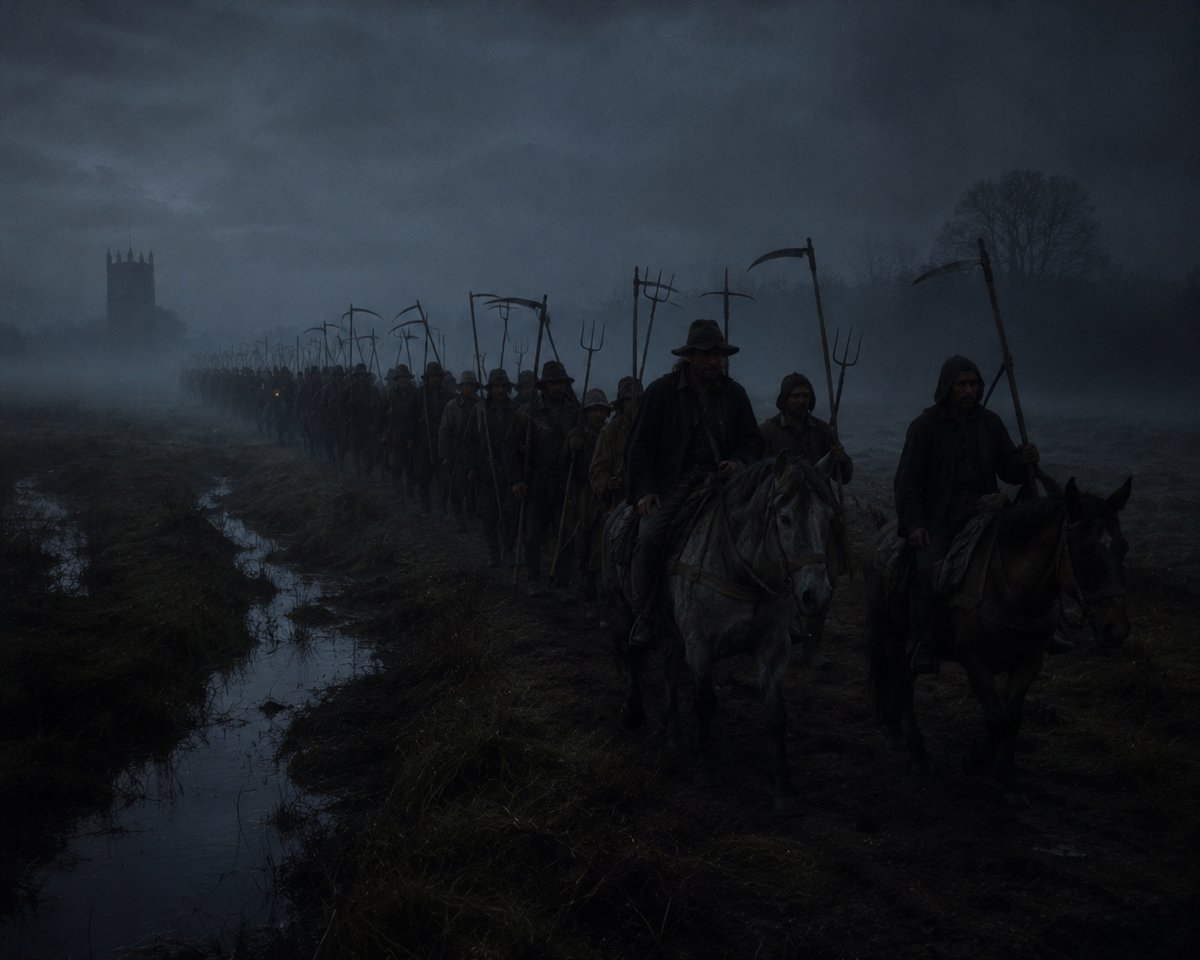
The silent night march across the moor. Illustration generated for this story.
They went out of Bridgwater near eleven that night, the sixth of July drawing on, in a silence so total it was its own kind of terror. The word had gone down the column that any man who spoke, any man who let his pot clink or his horse whinny, was to be killed where he stood, for the lives of all of them hung on the king's men not waking. So they moved like the dead, thousands of them, out along the old Bristol road toward Bawdrip and then turning south down the dark lanes, Bradney Lane and Marsh Lane, the horse going ahead, feeling for the crossings. A mist came up off the moor and lay on them cold and wet, and there was no moon worth the name.
And the road took them past the place their name had come from.
Edward had not let himself think on it, but there it was. Off to the left in the murk, no more than half a mile, lay the village of Chedzoy. He had set foot in it perhaps twice in his life. It was not his home; his home and his mother and the loft he and Robert had whispered in lay far behind them now, miles to the south beyond the Tone, where St Gregory's tower stood over the willow beds and the cattle. But this was the place the name had come from, generations back, the village that had put the word Chedzoy upon his family and sent it down the years to him. He could not see its tower in the dark, but he knew it was there, off to the left, square and patient, watching. It was a strange and terrible thing, he thought, to be marching to a battle past the one spot on earth that had given him his name, a place he barely knew, as though the name had reached back through all those years to call him home to die.
He found his brother's sleeve in the dark and gripped it. Robert gripped back, once, hard, and that was all. There was no speaking. They walked past their whole boyhood in the fog, toward a field where men were waiting to kill them, and Edward thought that if he lived to be a hundred he would never know a stranger or a sadder thing than marching in silence past his mother's roof in the night.
Then it went wrong, the way Edward had known in his bones it would. They came up against a wide ditch, the Langmoor Rhine, and in the dark and the mist young Godfrey could not find the plungeon, the plank crossing, and the whole vast column ground to a halt in the bog while he cast about for it. The minutes stretched. And out in the blackness ahead a king's cavalry trooper, posted to watch the moor, heard or sensed something wrong, and fired a single pistol shot into the night, and turned his horse and galloped for the camp to raise the alarm.
The shot went across the moor like a stone dropped into still water. Edward heard it and felt it land in his chest, and he knew, with a calm that surprised him, that the one thing the whole plan depended on was gone. The dark would not hide them now. The king's men were waking.
Beside him Robert's lips were moving, and Edward leaned close and heard that he was praying, steady and low, the words of a psalm, and not one of them was afraid.
Sedgemoor
What came after, Edward could never tell whole. It came back to him for the rest of his life only in pieces, the way a smashed thing comes back, and the pieces did not fit.
With the surprise lost the Duke flung his horse forward to do what the foot could no longer do quietly. But the horse could not find the crossing either, and met a wall of musket-fire out of the dark, and broke. The bolting plough-horses came crashing back through their own foot, and men went down screaming under their own cavalry. The foot regiments came on in the dark, Red and Blue and the rest, down to the edge of the great Bussex Rhine, and there they stuck, because they could not get across, and so they stood on their own side of the ditch and fired blindly at the muzzle-flashes on the far bank, and the king's gunners found them.
The cannon was the thing Edward never forgot. Not the noise of it, though the noise was the end of the world. It was what it did. It would come down the packed ranks like a scythe through the very willow he cut, and where there had been men standing there would be a gap and a wet darkness and a sound from the ground. He had his pole in his hands and he never struck a blow with it. There was no one to strike. There was only the ditch they could not cross and the iron coming out of the dark.
And then the grey came up in the east, the dawn, and with the light the king's horse found the plungeons at last and crossed and came round on the flanks, and the regulars found that the great rhine was shallow after all and waded it, and the thing stopped being a battle and became a slaughter.
"Rob!" He was shouting it, he realised, in the press and the smoke. "Robert!"
His brother was there, then he was not, then a surge of running men carried Edward sideways and down. He was on the ground. There were boots and hooves. He got up because to stay down was to die. He had lost the pole. He had lost his brother. The light was coming up grey over a moor strewn with his own kind, and through the drifting smoke he saw red coats moving among the fallen, and a man on a horse shouted something, and then there were hands on him, hard hands, and a blade at his throat, and a voice telling him to yield or die, and Edward Chedzoy, who had never wanted any of it, yielded. He was taken on the field of Sedgemoor in the first light of the sixth of July, alive, and that was the worst luck and the best he ever had.
The Steeplehouse
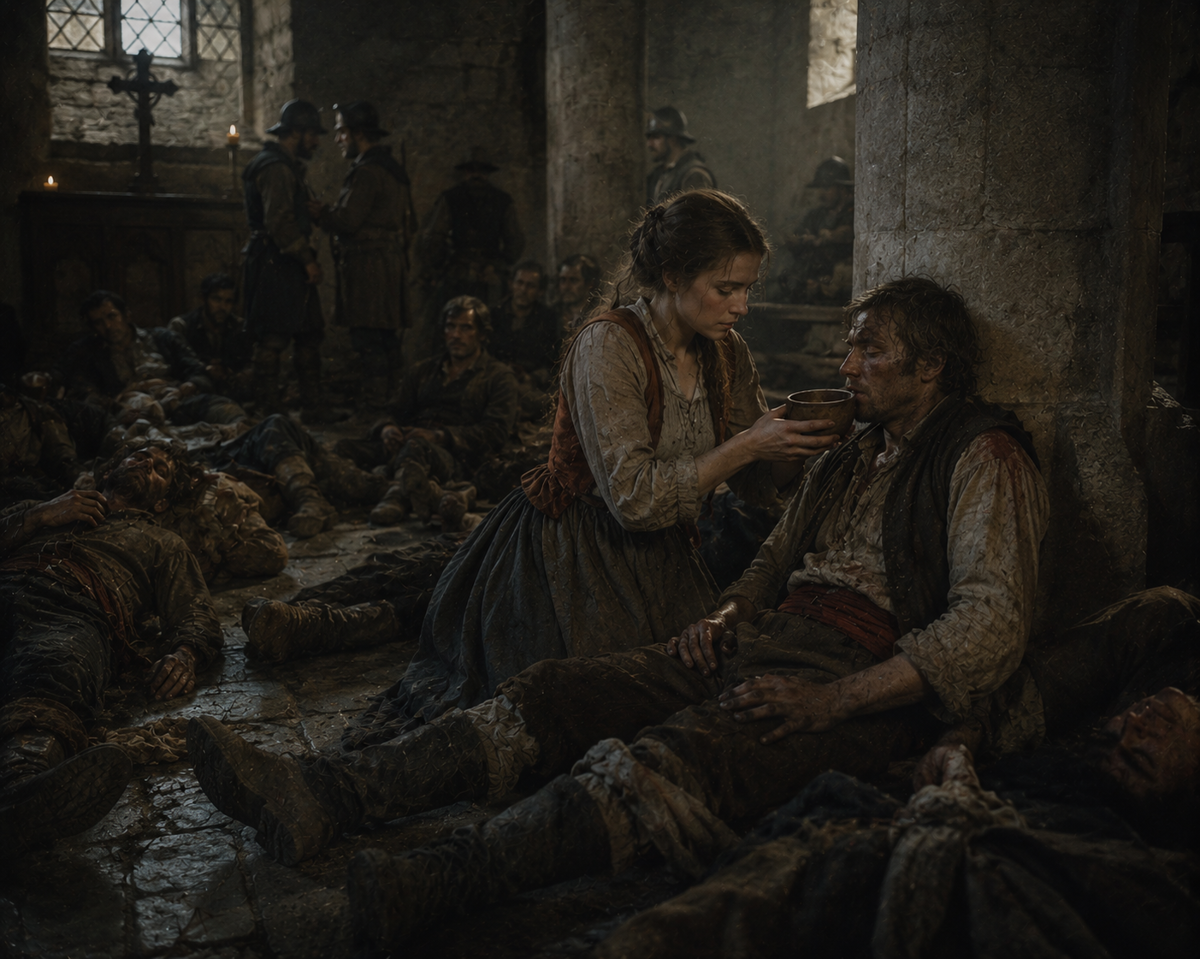
Mercy in the steeplehouse prison. Illustration generated for this story.
They drove the prisoners into the church at Westonzoyland, St Mary's, near five hundred of them, and shut the doors.
Edward was among them, and he had found Robert again in the herding, or Robert had found him, the two of them bound and bleeding but whole, and they clung together in the press of bodies under the high cold roof. The soldiers had stripped them as they came in, taken the buckles and the coins and the few poor valuables off them, and now they left them there without food and without water through the long hot day and the longer night, the wounded groaning, the dying calling out, the air gone foul with the breath and the blood of five hundred frightened men.
The thirst was the worst of it. Edward had never known a thirst like it, his tongue gone thick, his lips splitting. Some of the men prayed and some of them wept and some of them only stared. Five of them died in the night, and Edward heard each one go.
And then, in the small hours, the mercy. The little north door opened a crack, and a man came in soft as a thief, the churchwarden of the village, Richard Alford, and with him his daughter, a girl no older than Joan, and they had brought water. They went among the prisoners in the dark, the girl kneeling, holding the cup to cracked mouths one after another, her face white and set and full of a terror of her own, for if the guard woke they would suffer for it. Edward drank when the cup came to him and could not speak, and the girl looked at him for a moment, just a moment, and there was no judgement in her face, no king's man or rebel, only a girl giving water to the dying because they were thirsty. He thought he would remember that face longer than he remembered his own. He was nearly right.
There was a man near them, a young fellow called Francis Scott, who watched the little north door after the Alfords had slipped back out, and watched the guard nod toward sleep, and at last, in the deepest part of the night, eased it open and went through it and out into the standing corn and was gone. No shout went up. He had simply chosen the open door.
"Go," Robert breathed, his eyes on the door. "Ned. The door. Go now."
"And leave you?"
"I can't run, look at my leg. You can. Go."
Edward looked at the door, the thin grey line of freedom at its edge, and he looked at his brother on the cold stone, and he made the same choice he had made by the river, the only choice he had in him to make. "No," he said. "We came together. We'll go on together. I'll not spend my life in a cornfield wondering what they did to you."
Robert wept then, the only time Edward ever saw him weep, and he did not have the breath to argue.
In the days that followed they learned the rest, in fragments, from the guards and from new prisoners. The dead of the moor were being buried in great pits out on Sedgemoor, more than a thousand of them. And a week after the battle, twelve men of the village of Chedzoy were summoned with their carts and their horses to go out onto the moor and help heap the earth over the corpses. Edward thought of those men of Chedzoy, the village that had given his family its name, going out with their shovels to bury what was left of the West. Some of them, for all he knew, were distant blood, men who bore or had once borne the same name he did. He hoped to God none of them found a face they knew.
Gaol Fever
They marched the survivors off the moor and into a summer of small cruelties.
To Bridgwater first, and then on toward Taunton, chained in coffles like beasts driven to a fair. At Taunton, before any judge had so much as opened a book, nineteen men were hanged, simply hanged, as a lesson and a convenience. The officer who had the country in his keeping was a Colonel Kirke, and the soldiers said his men were called Kirke's Lambs in bitter jest, for their flag bore a lamb and their hands were anything but gentle. Kirke hanged men for sport and for example, and worse, he sold mercy, taking the money of desperate families for a safe-conduct or a promise and then sometimes hanging the man anyway. Edward learned in those weeks that there is a kind of evil that is not hot at all, that is bored and businesslike, and he found it more frightening than the cannon had been.
The order came at last that the rebels were not all to be hanged out of hand but held for trial, and so the great sorting began, men packed into every gaol the county could offer, Bridgwater and Taunton and the county gaols at Ilchester and Shepton Mallet and Wells. Edward and Robert were driven, still chained together, to one of them, and the door shut on them, and Edward looked at the place that was to hold them and felt his heart go down into the wet ground.
It was a stone room never meant for the numbers crammed into it. There was no air. There was filth past describing. There were men already sick in the corners, and men who had given up, and men who still talked of pardons and the Duke escaped to France, though they all knew by now the Duke was dead, taken in a ditch in Dorset and butchered on Tower Hill by a headsman who needed five blows to do it.
Robert's defiance held, those first days. He kept the men around them in heart, told them God was not done, that a king who had to murder a thousand of his own subjects to keep his crown had already lost it in the sight of heaven. Men listened to him in the dark the way they had listened in the alehouse. But Edward, lying against his brother's side in the foul straw, felt how hot Robert's skin had become, and how fast his heart was going, and the old cold fish turned over in the deep water of him.
The fever came up out of the filth and the crowding the way it always did, in those years, in those places. The men called it the gaol fever and they feared it more than the rope, for the rope at least was quick and had a reason. The fever had no reason. It went through the packed cell from body to body, carried, though none of them knew it, on the very lice in their clothes, and it took the strong as readily as the weak, and often the strong first.
It took Robert.
It began with the shivering, in a cell so close that no man was ever cold, and went to a heat that frightened Edward to touch. Robert's eyes grew bright and then grew strange. By the third day he did not always know where he was. He talked of the withy beds and of their father and once, terribly, of flowers in the streets of Taunton, his hand moving on the stone as if to gather them. Edward held him through it. He gave him his own share of the foul water. He kept the others off him and kept him as clean as a man can be kept in such a place, which is not clean at all, and he prayed, he who had never had his brother's faith, he prayed in the dark with a fury that surprised him, for a bargain, for a trade, for anything.
Near the end Robert came back to himself for a little while, the way the dying sometimes do, and his eyes found Edward's and held them, and they were clear.
"I brought you here," he said. His voice was a ruin. "I talked you off the island and I brought you to this. By the river. I made you come."
"You didn't make me," Edward said. "I came for you. There's a difference, and I'll not let you die thinking there isn't."
"Live, then." Robert's hand closed on his, with the last of a strength that had once thrown grown men in the wrestling. "Whatever they do to you. Wherever they send you. You live, and you remember it true. Not the way the rector will write it. The way it was. Tell it true, Ned. Promise me you'll live to tell it true."
"I promise," said Edward, and meant it more than he had ever meant anything.
Robert died before the morning, quietly in the end, his head on his brother's arm, in a stone room in the West Country with no judge having ever heard his name and no clerk writing it down. He was never tried. There was no record made of him, save the one his brother carried out, which is this one. The bold man, the lit man, the one who had wanted it, was gone, and the cautious one, the one who had wanted only the willow and the girl, was left alive in the dark with a promise to keep.
The Bloody Assizes
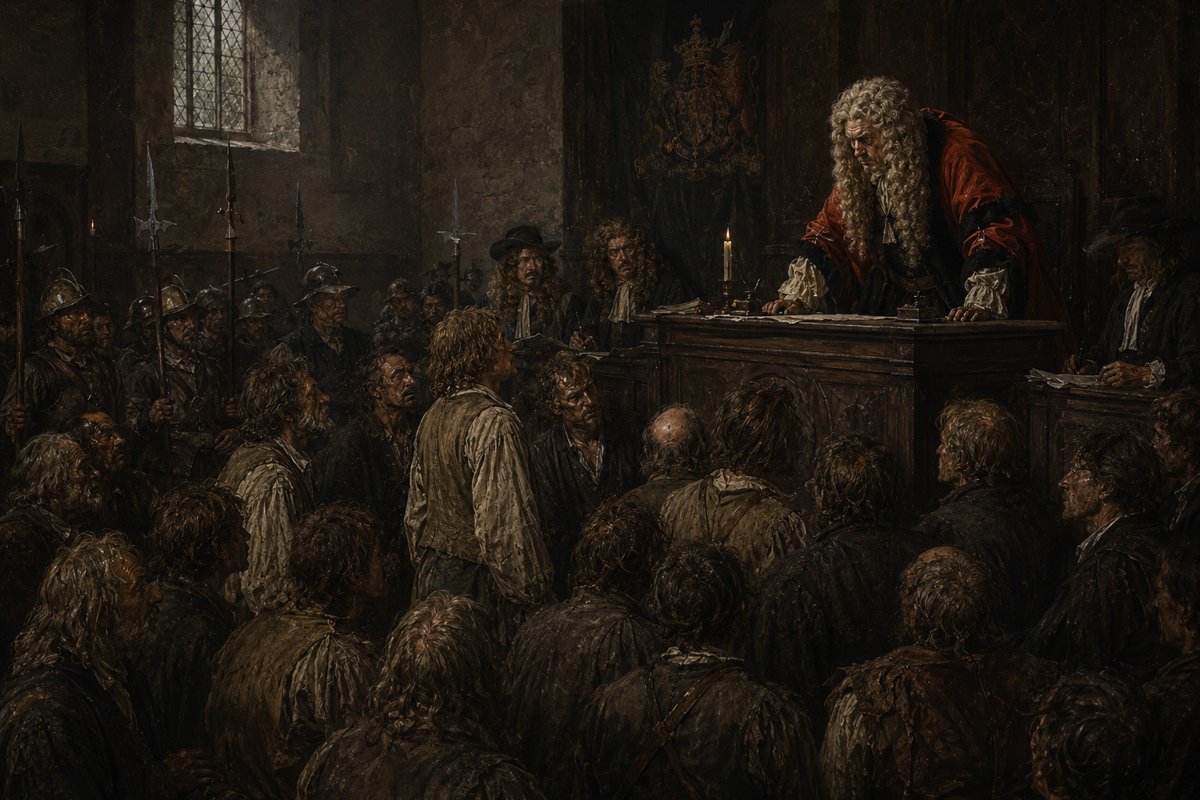
Before the bench at the Bloody Assizes. Illustration generated for this story.
The judges came west in the autumn, when the gaols had done their slow work and the survivors were fewer.
The great assize had opened away to the east, at Winchester at the end of August, and come west by stages, to Salisbury and to Dorchester at the start of September, where the hangings began in earnest, and on to Exeter, and to Taunton in the middle of the month, and at last to Wells on the twenty-third of September, 1685. The man who led it was the Lord Chief Justice, George Jeffreys, and his name went before him like a cold wind. They were calling it already what history would call it ever after, the Bloody Assizes.
Edward was brought to Wells in a great drove of prisoners, grieving, gaunt, alone in the way that only a man who has buried his other half can be alone. He understood very little of the law of it. What he understood, because the gaolers made sure of it and because the men passed it down the chain in frightened whispers, was the one thing that mattered. A man who pleaded not guilty and was convicted, as he surely would be, would hang, and be drawn, and be quartered, and his parts would be boiled in pitch and set up on poles about the villages to rot. A man who pleaded guilty and threw himself on the king's mercy might be spared the rope and sold instead across the sea. Jeffreys had made the choice plain to terrify them, and it worked. They pleaded guilty in their hundreds.
It was less a trial than a tide. Near five hundred and forty men were sentenced at Wells in that single day, herded through, named, condemned, moved on, the whole machinery of it grinding without pause from morning to dark. Edward stood in the crush of it, and when his moment came it lasted no time at all. A name, his name, in the clerk's rough spelling. The charge, that he had levied war against the king. The question. And Edward Chedzoy, who had promised his brother he would live, muttered the word almost under his breath, for he was timid by nature and had never in his life stood in a court, and the whole terror of the place was on him. "Guilty." "Speak up, boy!" the judge snarled down from the bench. "Or by God you'll be swinging from a gallows before the sun is down. How do you plead?" And Edward forced it out a second time, louder, though his voice shook on the saying of it. "Guilty, my lord." It was the word that would keep him breathing and take him from England forever.
He was sentenced to transportation beyond the seas, to be sold, to labour for ten years in the king's plantations in the Americas. He heard it the way a man hears a thing happening to someone else. His name, the family always said after, was among the last read out that day, near the bottom of the long roll of the condemned, as though even the clerk's hand was tiring. He thought, as they led him out, not of the ocean he had never seen and could not imagine, but of a pit on Sedgemoor where his brother was not, for Robert had no grave at all, and of his mother on the island, who would now lose both her sons in a single season, one to the earth and one to the water.
The Constant Richard
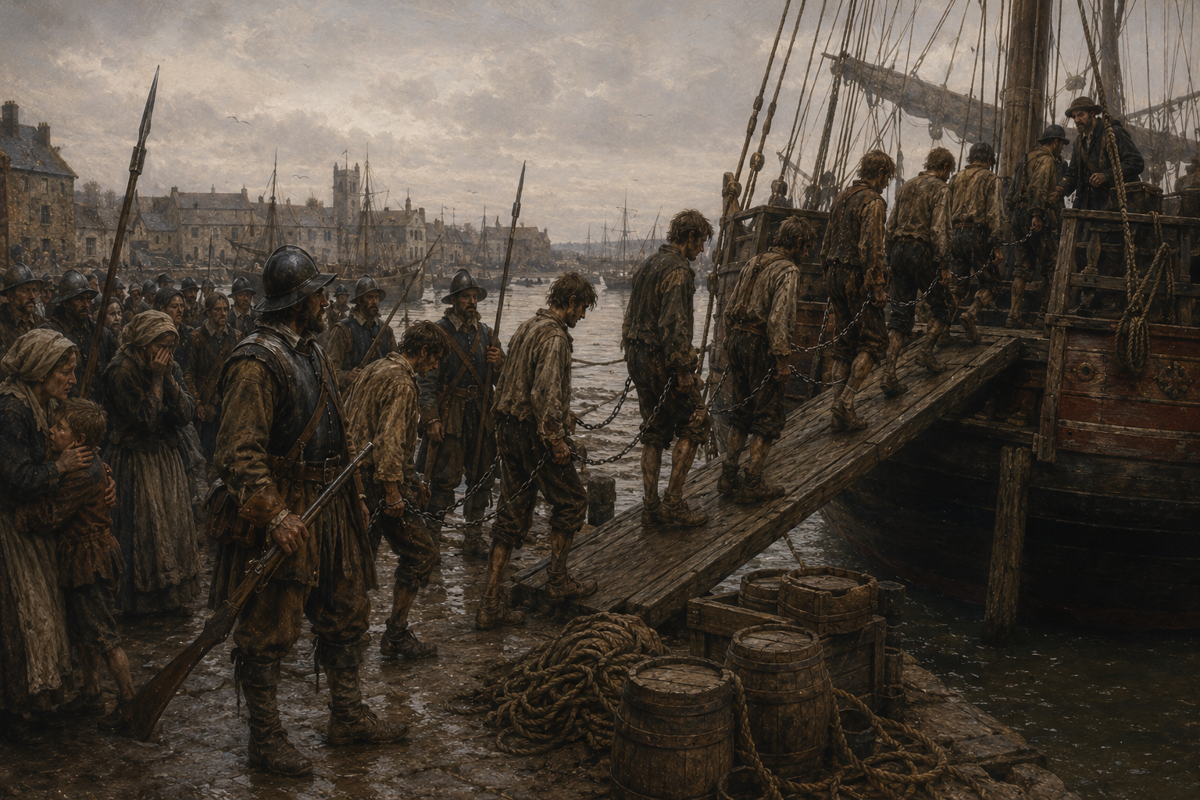
Herded aboard at the quay, the last of England behind them. Illustration generated for this story.
They did not even pretend the men were anything but goods.
The transported rebels were handed out in batches to the king's courtiers and favourites, who had begged for them as one might beg for a grant of money, because a convicted rebel was worth ten or fifteen pounds on a plantation wharf and there were near a thousand of them to be sold. Edward heard that one gentleman of the court had been given two hundred men to sell, two hundred souls signed over with a stroke of a pen. He and his fellows were a cargo, priced and consigned, and in the manifests that carried them they were listed not as men but as so many head, valued in the foreign coin of the sugar islands at so many pieces of eight apiece.
His ship was the Constant Richard, bound for Jamaica on the account of two merchants named White and Heywood, and she took on her cargo of eighty-four men in the late autumn and stood out into the Channel near the end of October. Edward had never been on the sea. He had never been further from home than Taunton in his life. Now the green coast of England, the only land he had ever known or wanted, drew down into the grey water astern, and he watched it go from the foul dark of the hold through a grating, and he did not weep, because by then he was past it.
The crossing was a thing out of a sermon on hell. Packed below in the dark, in their own filth, in the heave and stink of it, on a few hard biscuits and water gone green in the cask, the men sickened and died. Edward learned the rhythm of it, the moaning, the silence, and then the dragging of a body up to the deck and the splash, and another West-Country man gone into the deep with no marker and no prayer but what his fellows could whisper. On a ship much like theirs, the men said, two and twenty of every hundred died before they raised the island. Edward did not let himself count.
He was kept alive by two things. One was the carpenter, John Coad, the steady Bridgwater man from the Castle Field, who by the grace of God was on the same ship, and who had a way of fixing his mind on small concrete things, the splicing of a rope, the words of a psalm, the names of his children, that he passed to Edward like bread. The other was the promise. Live, and tell it true. When the dark and the sickness came down on him and the easy thing would have been to let go, Edward held to his brother's voice in the gaol, and he made his thirst and his nausea into a small grim labour, a thing to be got through hour by hour, the way you get through a wet day in the withy beds. And in time, gaunt as a hurdle, more bone than man, he was alive when they raised the green mountains of Jamaica out of the haze, which is more than most of the dead of the Constant Richard could say.
Sugar and Bondage
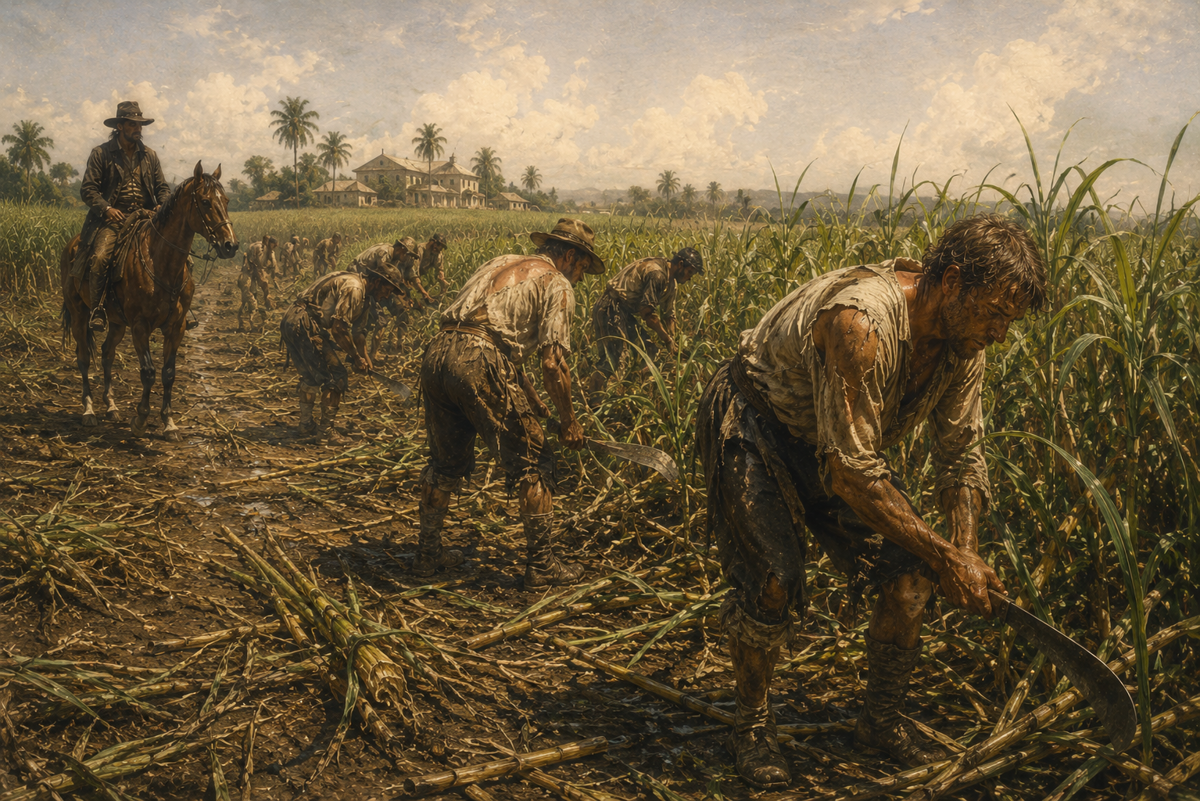
The cane fields of the Indies. Illustration generated for this story.
They were fattened before they were sold, like beasts at a fair, because a skeleton fetches no price. Fed up for a few weeks until they could stand and work, and then sold off the wharf to the planters, one by one, for the term of ten years.
Edward went to a sugar estate in the hot green interior, and there he learned a labour that made the hardest day on the Levels seem like a Sabbath. The cane stood higher than a man and its leaves cut like knives, and the sun was a weight that pressed the breath out of him, and the work went from the dark of the morning to the dark of the night through a heat his Somerset body had no defence against. He cut cane until his hands were one wound. He fed the mill that crushed it, and learned to fear the mill, for it took the fingers and the arms of the careless and would take the whole man if he stumbled. He boiled the juice in the great coppers in a heat like the inside of an oven.
He was a bondsman, an indentured servant, sold for a term of years, and the law called him a different thing from the enslaved Africans who laboured in the same fields under the same sun. Edward could not always see the difference, in the cutting and the heat and the overseer's whip, though he came to understand that there was one, and a deep one: that his term would end, if he lived, and theirs would not, not ever, not for them nor their children nor their children's children. He had been a free man of Somerset who had thrown his freedom away following his brother, and he would have it back at the end of ten years, God willing. The men and women cutting beside him had never had it to throw and never would. He was a long time understanding what he was looking at, for he was only a peat-cutter from the Levels and the world had never asked him to think on such things, but he worked beside them year on year, and he was not a stupid man, and in the end he understood enough to carry it heavy in him for the rest of his days.
He marked the time by the only calendar he had, the cane. Planting and growing and the great burning and the cutting and the crushing, round and round. He grew brown and lean and quiet. He thought of the willow, and of his mother, and of Joan Hurd, who would surely have married by now, and would be right to. He thought of Robert. Some nights he could not call up his brother's face and it frightened him worse than the mill. Most nights he could, and that was worse still. He held to the promise the way a drowning man holds to a plank, because it was the only thing left that had his name on it. Live, and tell it true. So he lived. There did not seem to be much telling, in a cane field at the far edge of the world, but he lived.
The Turning of the World
The world turned over again while Edward was bent in the cane, and it was a long time before the news of it reached him.
In England, the people had at last had their fill of their Catholic king. They had put him off his throne and sent for his Protestant daughter and her husband out of Holland, and done it almost without a shot, and called it a glorious thing. James, who had hanged and sold a thousand West-Country men to keep his crown, had lost it after all to the very fear that had driven the rising, and lost it to men in London who paid nothing for it, while the bones of Sedgemoor lay in their pits and Edward Chedzoy cut cane in Jamaica for a sentence handed down in that dead king's name.
And then, slowly, the mercy that the new order could afford. Free pardons were issued in the early part of 1690 for the transported rebels who yet lived. By the year after, perhaps half of them in Jamaica had been let go. But a pardon is a paper thing. They were freed and given nothing, not a coin, not a passage, and the sea between Jamaica and Somerset was as wide and as costly as it had ever been. A free man with empty hands at the far side of the ocean is free only to choose which shore he will be poor on. Edward's release was set down in the rolls in the February of 1691, in among that great turning of pardons, ten years almost to the season since the colours had come into Bridgwater.
What he chose, no record says, and that is the truth of it and not a failing of it, for a sold servant who lived was very seldom written down again. There was no ledger that troubled to note whether Edward Chedzoy of Stoke St Gregory took ship for home or stayed and made a life under the green mountains. The silence is not his death. The silence is only that the world had stopped keeping count of him, as it stops keeping count of all ordinary men once it is done using them.
So let it be told the way the family told it, which is the only way it ever came down. That somewhere in the heat of that island a lean brown Somerset man, free at last and with nothing, stood and reckoned what his survival had been for. That he had made a promise to a dying brother in a stinking cell, to live and to tell it true, and that he had done the first part against all the odds the sea and the cane could throw. And that the second part, the telling, he set in motion the only way a man with no paper and no schooling could: he told it. To whoever would listen. A story of two brothers and an island in the moor, and a night march in the fog past the dark village their name had come from, and water carried in the dark, and a fever in a cell, and a ship called the Constant Richard. He told it, and it was told again, and again, down all the years and all the generations, growing a little and losing a little in each telling, the way such stories do, until it crossed the same ocean that had carried him and came at last to a man with the same name, sitting in the same county, who set it down.
That is the telling. Robert never came home, and never had a grave, and was never written in any record but this. Edward kept his promise. He lived. And here, three hundred years and more along the road, it is being told true, the way he asked. The island is still there in the moor. The church still stands. And the brothers of Chedzoy are remembered.
Author's Note on Sources
This is a work of fiction built on a frame of fact, and I think it only honest to mark where one ends and the other begins.
What is real. Edward Chedsey (the surname is spelled many ways in the old records, Chedzoy and Chedsey among them) was a real man, baptised at Stoke St Gregory on 11 June 1663, convicted in the Bloody Assizes and transported to Jamaica on the ship Constant Richard around 31 October 1685, one of eighty-four men consigned to the merchants White and Heywood, his release formally enrolled on 4 February 1691. The Monmouth Rebellion is real in every public particular: the Duke's landing at Lyme Regis on 11 June 1685, his proclamation as king at Taunton on 20 June, the failure before Bristol, the night march out of Bridgwater and the Battle of Sedgemoor in the early hours of 6 July, the herding of some five hundred prisoners into Westonzoyland church, the water carried in by the churchwarden Richard Alford and his daughter, the escape of Francis Scott through the north door, the burial of the dead in pits on the moor and the summoning of twelve Chedzoy men to help, Colonel Kirke, and the Bloody Assizes under Judge Jeffreys, which finished at Wells on 23 September 1685 with around five hundred and forty men sentenced in a day. Richard Godfrey the herdsman, the Reverend Andrew Paschall the royalist rector of Chedzoy, John Coad the transported carpenter, and Henry Pitman the rebel doctor were all real people.
What is invented. Robert is preserved in family tradition rather than in the record: it was said that he was not tried, and so it was assumed he died in prison before the assizes. From that single thread I have made him the elder, bolder brother who talks Edward into the rising and then dies of gaol fever, a death entirely plausible for those lethal, overcrowded cells, where deaths went routinely unrecorded. His character, his words, and his end are my invention. So too are the brothers' inner lives, their dialogue, Edward's sweetheart Joan Hurd, the daily texture of the village, and the detail of Edward's years in Jamaica. Their parents, Robert and Elizabeth Chedzoy, are real names from the family record; the people I have drawn around those names are imagined.
One correction. A note in the family papers gives Edward's trial as 8 July 1685 at Wells. That cannot be right: the battle was fought on 6 July and the assizes had not yet begun. The Wells assize sat on 23 September 1685, and that is the date used here. The error is an easy one, and a common one, for at least one printed source even mis-dates the battle itself.
A word on the name. The family were called Chedzoy after the village of that name near Bridgwater, from which an ancestor had come. The brothers' father was himself a Robert Chedzoy, so the family already carried the name and was settled at Stoke St Gregory — where Edward was baptised in 1663 — at least a generation before the rising; the departure from the village of Chedzoy itself lies further back than the records gathered here can show. It is at Stoke St Gregory, therefore, that I have set their home. The village of Chedzoy enters the story as itself only twice: as the place the name first came from, which the night march out of Bridgwater happened to pass, and as the village whose twelve men were sent out to bury the dead of Sedgemoor.
And one legend, set aside. There is an old tradition that the rebels sharpened their blades on the buttresses of Chedzoy church before the battle. Historians doubt it, for the army skirted Chedzoy in the dark and never entered the village. I have left it out of the story as fact, as a careful teller should.
The fuller history of the Chedgzoy name, the village, and the line that descends from this family is set out on the Chedgzoy name page.
References
- Monmouth Rebellion (Wikipedia)
- Battle of Sedgemoor (Wikipedia)
- Bloody Assizes (Wikipedia)
- The Battle of Sedgemoor (Zoyland Heritage Fund)
- English Heritage Battlefield Report: Sedgemoor 1685
- The Battle of Sedgemoor (Battlefields Trust)
- The Battle of Sedgemoor (Prince Rupert's Bluecoats)
- Chedzoy (Wikipedia)
- Chedzoy Village History (Parish Council)
- St Mary's Church, Chedzoy (Wikipedia)
- Revd Andrew Paschall's account of the rebellion (South West Heritage Trust)
- The Constant Richard, 31 October 1685 (Warwalks)
- 1685 Bill of Lading, rebels shipped to Jamaica (Rum Butter)
- John Coad, A Memorandum of the Wonderful Providences of God (Internet Archive)
- The 17th-Century Adventures of Henry Pitman (The Historian's Hut)
- The Monmouth Rebellion: pardons and transportation (Merriott Families Genealogy)
- Letter from Port Royal, Jamaica, 1687 (Jamaican Family Search)
- Gaol Fever (Legal History Miscellany)
- Chedzoy surname and variants (Surname Database)
Definitive identification of Edward and Robert as individuals rests on W. MacDonald Wigfield, The Monmouth Rebels 1685 (Somerset Record Society, vol. 79), the roll-call of rebels with parish and punishment, held with the gaol registers and the Stoke St Gregory and Chedzoy parish registers at the South West Heritage Centre, Taunton.